
This post is based on an conversation with Artie Lynnworth, who has written several books on leadership, fitness, and career development.
Time is the Great Equalizer. No matter how important you are, how rich you are, or how ambitious you are, you get the same allotment of hours in a day that everyone does. 24 hours. 1,440 minutes. That adds up to over a half a million minutes in a year. How you use them determines how successful you’ll be.
Time management is comprised of two things: having a plan and making decisions, which means prioritizing. There’s a quote I included in my book in the chapter about time management and planning. Seneca, one of the great Stoic philosophers, lived from 4 BC to 65 AD. Here’s what he said 2,000 years ago:
“Our plans miscarry because they have no aim. If a man knows not to which port he sails, no wind is favorable”. In other words, if you don’t know where you’re going, how can you possibly decide how you’re going to get there? So the first step in time management is to know what you want to do – what goal you have set. Whether it’s starting a big project at work, organizing the garage, or planning a lifestyle change, it starts with a clear plan.
Author John Maxwell, in his book, Master What Matters: 12 Value Choices to Help You Win at Life, talks about the choices you must make every day. The key is focusing on what matters most, basing your choices on your values. Your values, once they’re defined, make decisions much easier. Knowing what to do, and what to do next, is clear because it’s not based on your mood or extrinsic reinforcement. There are fewer distractions. Your game plan determines your tactics.
Start a side gig or your own business. Get your Masters degree. Buy a home. My definition of a goal is a dream with an actual plan and timeline attached. There’s an often-used acronym for effective goals, S-M-A-R-T. Specific, measurable, achievable, relevant, and timed. “Get in shape” is not a goal. “Lose 15 pounds” is. “Get to the gym two days this week” is. Once you break your big goal into smaller steps, you’ll start seeing forward progress. At the end of every day, you get the satisfaction of noting what step(s) you took toward achieving your goal.
So half the battle is having a plan. The other half is making decisions, setting priorities in order to manage your time. Start simple. Just set down one thing you want to do today before the day is over. Take five minutes and say, I’m going to turn off the phone. I’m not going to be distracted; I’m going to set one specific goal for today.
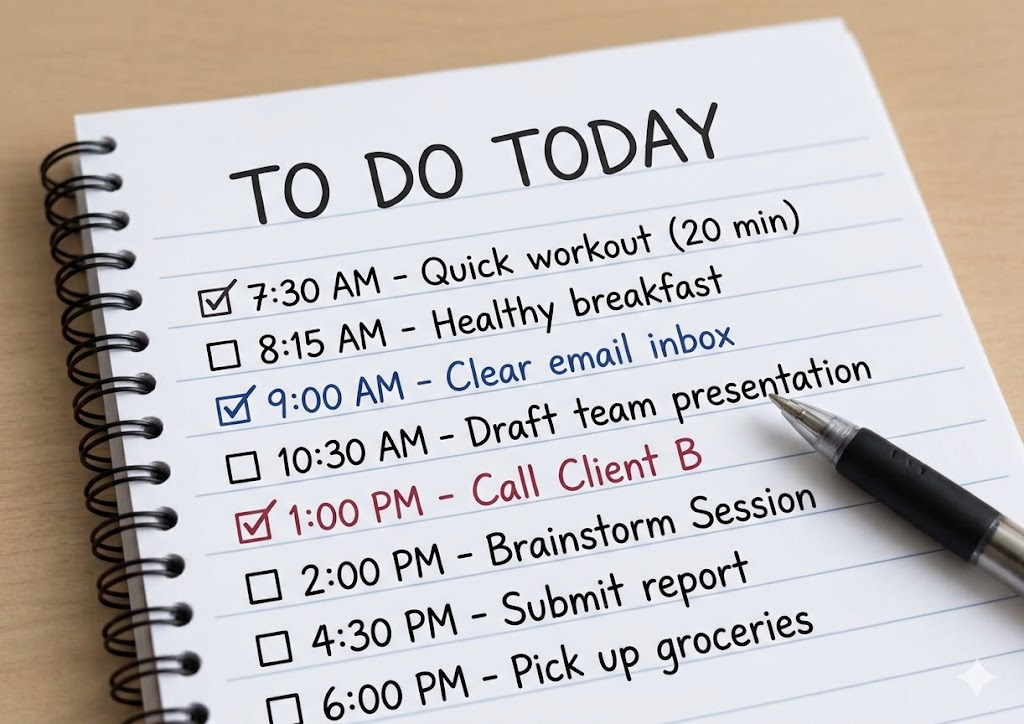
People love checklists for a reason. You get a hit of joy and accomplishment when you check an item off your list, no matter how small it might be. Those feelings cause momentum, and as you start to feel successful, you’re bound to do a little bit more. Pick something that is achievable for your first step. Make it small. It doesn’t really matter what you do; it matters that you do it.
When you get down to a daily plan, the question becomes what should you do first? My recommendation is to do the most important or the most difficult task you have on the list first. It’s tempting to begin by knocking off the easy items on your list first. That’s not a bad start – get them done. But if you tend to procrastinate with the tough one, it’s almost inevitable that urgent things will come up, and you’ll find yourself at the end of the day with that big item still on your list.
And even if you only get one important thing done a day, that’s 365 important things done a year.
But how can you become more efficient with your list of goals? There are three D’s that have helped me manage my time effectively.
- Delegate first. Let somebody else deal with it, or pay someone to get it done.
- Delay. Change your mindset about urgency so you can focus on and finish the more important task.
- Delete. I’m not going to do it. Let it go by. Time will tell you if it was indeed important. You can always add it back to the list later if it was.
There’s another tip that has worked for me. If a task is big or complex, I’ll set a timer to work as hard as I can at it for say, 30 minutes. Then I’ll set it aside until I make another 30-minute window the next day. You can accomplish a lot when you break it down into smaller segments.
Discover more from Your Work, Your Way
Subscribe to get the latest posts sent to your email.

