

Jeffrey Yip Ph.D., writing for Psychology Today, says that many leaders interpret resistance to change (slow rolling implementation, raising objections long after a decision has been made, or non-compliance) as signals of toxic behavior. But Dr. Yip says “what looks like resistance is often fatigue, overload, or distress, not defiance.” It’s a signal of organizational pain.
Dr. Yip cites research on organizations that reveals that resistance “is less about the change itself and more about how the change is led, communicated, and experienced.” Workers are resisting because they don’t understand the change or why it’s happening or because they don’t feel safe in some way.
It’s easy to imagine change as a threat. From a new policy to new ownership, when something changes, someone is going to feel pain. Workers worry about having to change they way they work, learning new skills, or being put under more pressure to perform.
And of course, at all levels, workers worry about being replaced with processes and technology that can do their job more efficiently, more rapidly, and more accurately. The rise of AI in corporate analysis and decision making is clearly an existential threat for thousands of middle skills workers and middle management.
Research from Roy Smollen indicates that there are three distinct forms of resistance that can be clearly identified.
- Emotional: frustration, fear, and cynicism leads to gaps in trust or safety
- Cognitive: questioning and doubt leads to misalignment or unclear rationale
- Behavioral: delays, disengagement, and minimal compliance leads to overload or structural barriers
But Dr. Yip says that management can choose to use these signals as a pilot would use radar signals to decide when and how to adjust their altitude, speed, or direction. One way to get to the source of the resistance and one step further to reducing or eliminating it is a process he calls “painstorming.” It’s very much like brainstorming, only with negative thinking as the rule. He writes, “It reframes discomfort as diagnostic data.”
He’s developed a PAIN framework as a guide for bringing frustration, friction, and fatigue to the surface so they can be addressed. His graphic is below.
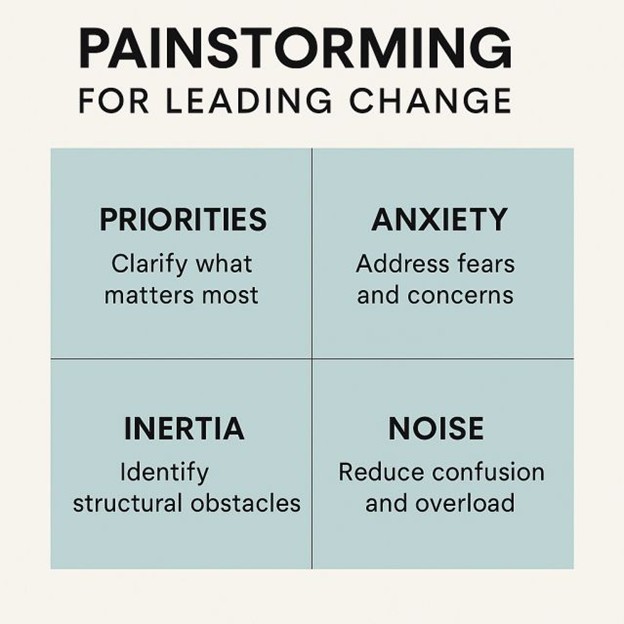
Change fatigue begins when initiatives compete for attention and resources. Clarifying priorities signals respect for people’s time and focus. Leaders and managers can ask productive questions about what workers are experiencing in the jobs: priorities that compete or seem to cancel each other out, and unclear directives about what is the most important thing to focus on right now.
Leaders who are brave enough to name anxiety reduce its power, Dr. Yip says. Leaders should ask workers what they’re worried about (performance, learning, changes that affect their job security, for example.) They should also ask what they could be doing to make workers feel more secure or supported through the change.
Inertia is not always about human resistance. Workers are sometimes saddled with inefficient tools or legacy systems that hold them back or require complex workarounds. Once leaders identify structural obstacles, they can begin to mitigate them or eliminate them.
Finally, noise can overwhelm and confuse even workers with the best intentions. Leaders can determine where mixed messages or misunderstandings might be competing with important direction.
Painstorming – otherwise known as complaining about change – is happening in the hallways and breakrooms anyway. Leaders who take the issues on in a supportive and open discussion can reduce resistance dramatically.
Discover more from Your Work, Your Way
Subscribe to get the latest posts sent to your email.

