
Ring the bells that still can ring
Forget your perfect offering
There is a crack, a crack in everything
That’s how the light gets in
- Leonard Cohen
If you’ve ever browsed an antique store or online marketplace, you’ll be familiar with the term “as is.” Nicks, scratches, dings, missing legs: as is. What “as is” means is that this piece has years on it. Experience on it. A couple of layers of ugly paint on it. Character on it.
We should all have a tag on us that declares that we are to be taken as is.
It’s our experience, our age, our flaws, and our mistakes that make us who we are. That makes us human. Becoming friends, lovers, or compatriots shouldn’t mean that expect each other to be perfect. We expect each other to do our best. To be our best, flawed selves.
That doesn’t mean that we won’t need help to be our best. A good friend, a good partner, a good parent, a good mentor, sees what’s underneath the layers of grime, paint, and rust, and knows that although the price may be negotiable, the value is inherent.
Abraham Maslow viewed the role of the teacher, therapist, and parent as horticulturists, whose task is to “enable people to become healthy and effective in their own style.” To Maslow, this meant that “we try to make a rose into a good rose, rather than seek to change roses into lilies.”
Our brokenness, whatever form it takes, makes us unique – and uniquely human. I am often struck by the fact that we almost never describe an animal (barring any accident or misfortune that has changed its looks) as “ugly.” The wrinkly Shar Pei is as beautiful, in its own way, as the sleek and athletic Doberman. A tabby cat is as beautiful as a calico or a black cat. Yet we describe humans as falling short of some ideal that we have tried for millennia to describe – and prescribe.
Women are especially victimized by this, since beauty standards change from generation to generation, even within a few years. It’s hard not to see that women who have the means (and a million Instagram followers) are all starting to look alike. Glassy skin and frozen foreheads. Kardashian lips. Perfect breasts and lifted butts. Young celebrities resemble blowup dolls more than interesting, flawed human beings.
Wear and tear creates character, in furniture and in people. The Japanese term wabi-sabi refers to a Japanese philosophy centered on finding beauty in imperfection, impermanence, and simplicity, encouraging acceptance of the natural cycle of life and the beauty found in things that are “imperfect, incomplete, and transient”. I have a beautiful cabinet in my home office with a small chip on the upper right corner. I touched it up a bit when I brought it home after receiving a $200 discount on it because it was damaged. No one has ever noticed the chip; I point it out to visitors to help them gain appreciation for “damaged” goods that remain beautiful and worth our admiration.
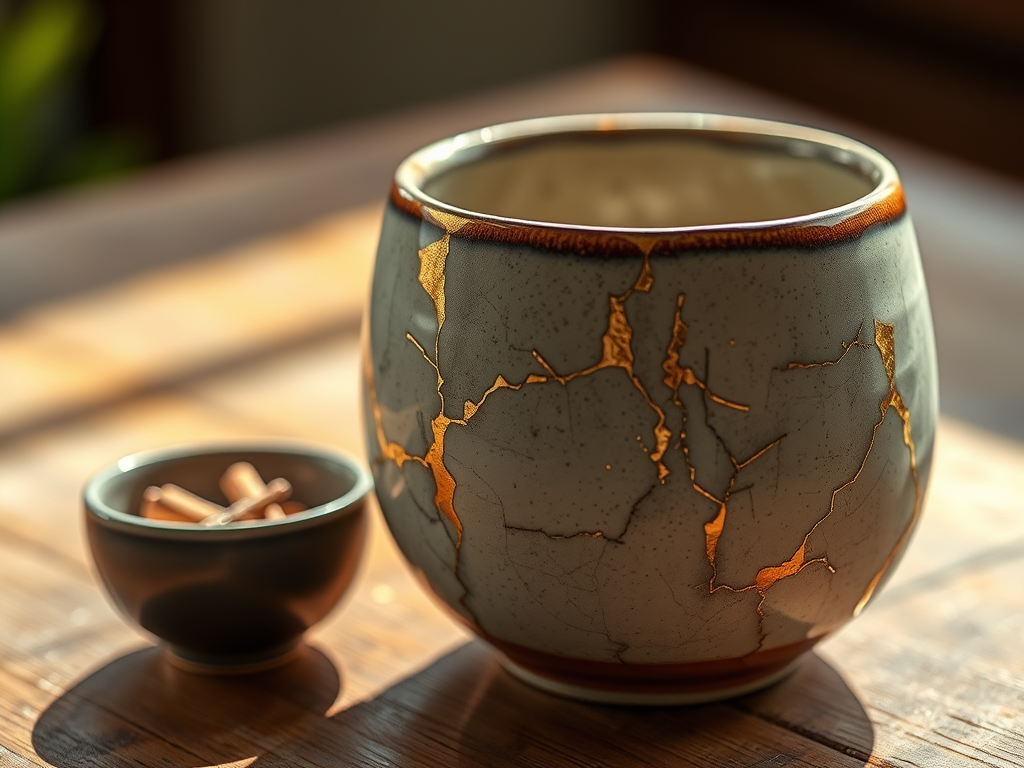
Instead of hiding our differences, our perceived flaws, in shame, we can make something beautiful out of them. The Japanese art of Kintsugi repairs broken pottery with lacquer and gold, silver, or platinum. The word kintsugi translates to “golden joinery” or “golden repair”. The result takes a mundane piece and turns it into art.
That’s our job as humans, to take our faults and breaks and disappointments and transform them into art. Some of us have the gift of actual artistry: the comedian who turns tragedy to comedy; the writer who turns their pain into a beautiful novel; the artist or dancer who interprets their life into something transcendent. But you don’t have to be an artist to convert your unique life into art. It only takes imagination to romanticize your story, to tell it in a way that becomes your own hero’s journey.
“As is” can become a rallying cry for your life. You’ll have to take me as is right now, but I’m on my way to becoming the best version of myself.
Discover more from Your Work, Your Way
Subscribe to get the latest posts sent to your email.

